The last daughters
Two daughters raising two sons.

“We’re the last daughters in our families,” my partner informed me a few months before our second son was born.
I laughed, saying: “My parents lost their daughter over fifteen years ago!”
But I asked her to clarify, slowly taking in her message to me.
“What do you mean?”
“Our mothers had daughters, our grandmothers had daughters, our great-grand mothers had daughters, you know? Every woman in the matriarchal lineage of our family trees had daughters. Until us.”
“Oh. That’s interesting” I said. The news sinking in.
We had just found out that our second child, still in utero at the time, was “a baby with a penis,” as some in my social network might say. A penis-haver.
With our first, we wanted the sex to be a surprise. So we waited.
For our second, we were *lightly* hoping for a daughter. Even our 5-year-old wanted a little sister. After 5 years of parenting an energetic, needs-less-sleep-than-average, independent, risk-taker, little boy, we were tired.
When I was a gender studies undergrad student my feminist philosophy professor, who I greatly admired, once said in passing that parenting boys was just “different.” It was one of the most suspect things I’d ever heard in a women’s studies classroom. At the time, I’d believed that any observable gender differences could be chalked up to socialization and the patriarchy. I let her comment slide. Twenty years later (and after many ethnographic “fieldwork” trips in playgrounds and birthday parties) I see she might have had a point.
My partner and I are both the eldest of three kids. Each of our families had two boys, one girl. We were the big sisters to two younger brothers. We—the last daughters in our families—are now in charge of raising our two sons. Some kind of relational pattern repetition has unfolded and it partly inspired writing this post about transness, childhood, and family-building.
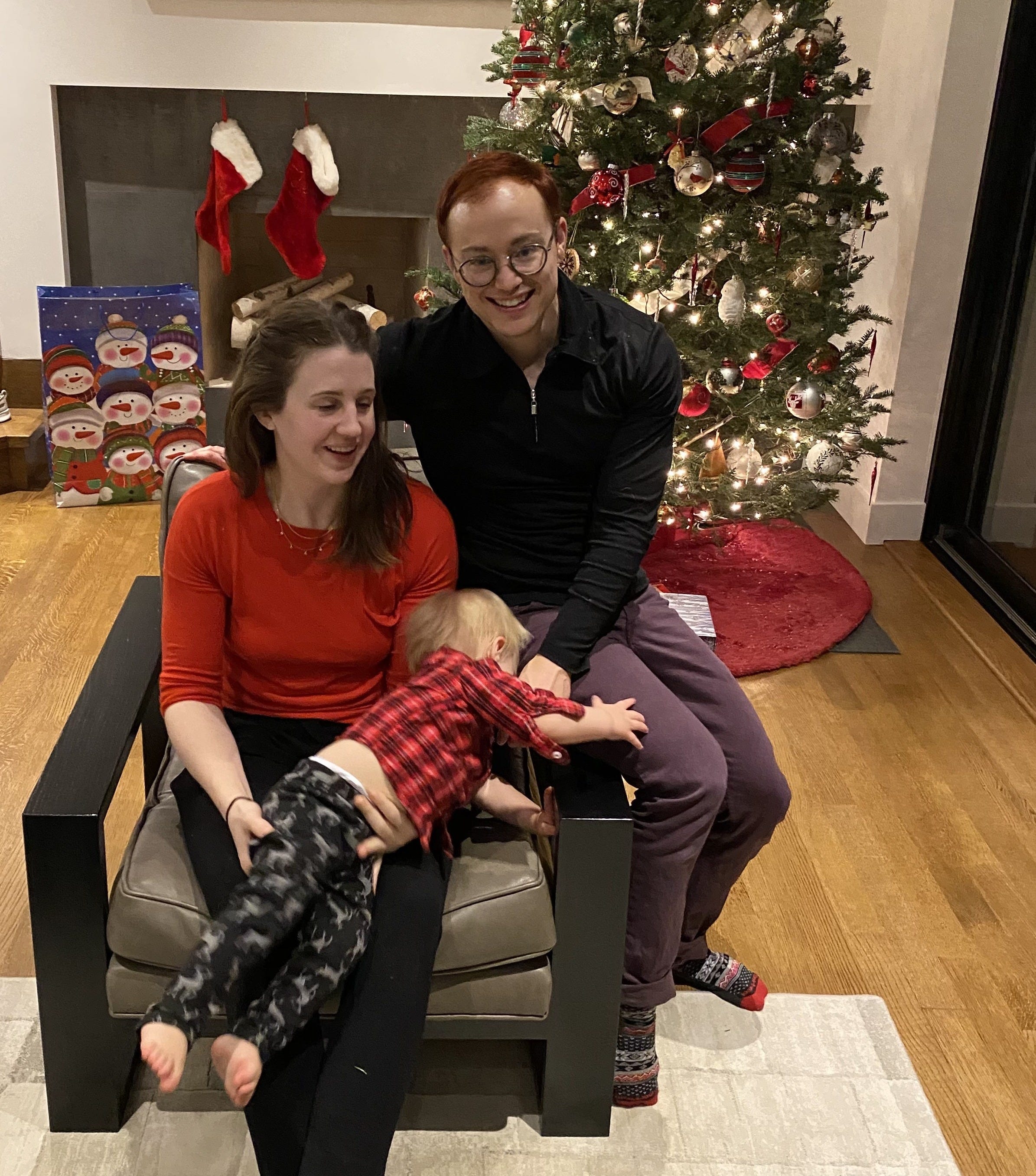
Back when our two kids were still just a conversation topic, my partner, a cisgender bisexual woman, once dryly joked that her body is “not capable of producing girls.” Girls, specifically. According to her own feelings, she isn’t feminine enough for that. (I’ve already written a post about what gender dysphoria is, and no, she does not have the made-up-classification of “cis-gender dysphoria”). Though, out of pure height dysphoria, jealousy, and strictly self-deprecating jokes, I once said she would have made a better trans man than me, standing 5’9” to my 5’5”! Wise cracks aside, it’s pretty funny how things panned out with having our two boys. Mother’s intuition?
After doing some research (a few google searches, to be fair), I learned that babies conceived via IVF are slightly likelier to be male. The research seems somewhat inconclusive, but apparently the skewed sex ratio in IVF has even been observed in non-human animals, such as cows and mice. I find this fascinating.
What’s going on in those petri dishes? Why are male embryos likelier to yield live births? How are they ranking embryos and selecting them for embryo transfers?Someone should do feminist science and technology studies on this, if they haven’t already. I’m sure that Colin Wright could use a new gender studies dissertation project from which to farm outrage porn on X.
Putting theory aside, we used IVF and now we’re now raising two boys. We’ve had on-going relationships with fertility clinics for the last six years. It began when I first went through the egg retrieval process as a PhD student, and it ended with the birth of our second child who is not even 2-months-old as I’m writing this. We are of course elated to have two beautiful sweet kids. One of them is a total terror (in an amazing way) and the other, well, we’ll see. Being a dad is truly a pretty cool job. But thank god we can move on from the fertility medicine stage of our lives.
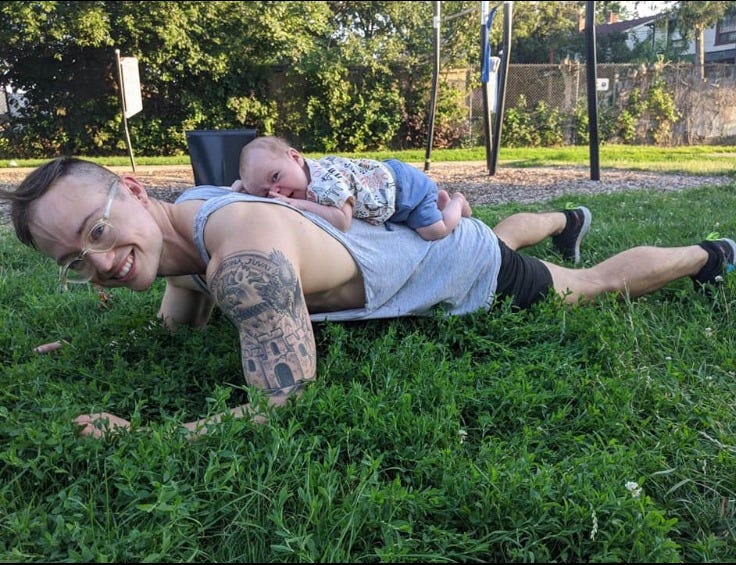
Although I started to transition in my early 20s, I lived the first half of my life—my entire childhood and emerging adulthood—as a girl. A pretty weird, masculine one, but still. I was my parents’ daughter. When I was growing up, “the boys” were my brothers.
“Go call the boys for supper,” my mother would say to me.
Today, my mother has displayed on her fireplace mantle a photo of me and my two brothers, all of us spread out in age across our 20s. The photo was taken at my cousin’s wedding. The pre-made picture frame declares the three of us “the boys.” It’s really quite sweet that my mother did that, after many years of struggling through two coming outs—my first at 19 and then again at 25. I think becoming a parent ourselves can better attune us to the emotional life of our own parents.
I know many trans men who, in hindsight, recall themselves to have been boys in childhood despite never having actually understood themselves as such at the time they were kids. In some cases they may have even identified strongly as girls at one point, until they eventually made a decision to transition, often in their late teens or twenties. This is really not how I conceptualize my own childhood and my subsequent early-adult transition, but I can understand how this kind of identity formation happens. A lot of it relates to gender dysphoria, but I think it can also confer some real practical and psychological benefits, post-transition. There have been times I’m in conversation with other dads (sometimes moms, but usually dads) where we’re talking about our childhoods, and assumptions are made about mine. “Must have been crazy growing up in a family with three boys. Your poor mother.” I don’t make a point of correcting these kinds of comments or assumptions, because in my experience of having tried it in the past, things can just get… awkward. “Well, actually, I was raised a girl!” There’s a time and place for that (like Substack).
However, I can see how it might be easier to muddle through these types of social pleasantries if I did internalize the grand, mainstream trans narrative that tells me I was *always* a boy. But I don’t see my life in that way.
Once one settles into a new gender/gender role, it can be hard to reconcile the past and explain it to others. Trans or cisgender, we are always re-telling our life stories in relation to the present context, grabbing for ideas and discourse, selecting certain memories over others in service of constructing a coherent narrative and sense of self. I indeed was always boy-ish. But I wasn’t a boy. I played on boys’ baseball teams, as the only girl. I had a rough-and-tumble childhood, raised in a rural community with a lot of freedom to roam. It was an idyllic Haidt-ian “play-based childhood.” At the age of 4, I roamed to the neighbour’s and taught myself to ride a bike. I “borrowed” it from a big Catholic family up the street who had 12 kids; they always had a couple bikes scattered all over their front lawn. A couple years later, in grade 1, I also “borrowed” an older boy’s bike from school to prove to my parents that I was capable of riding to school, after they said I wasn’t big enough. When I returned home and they realized what happened, I was made to phone up the kid, apologize, and return it. It was my mother’s hairdresser’s son. He had a BMX bike and a mohawk. By my undergrad, I did too.
I hope my kids can have a similar childhood: exploration, play, and learning from mistakes. Ideally with slightly less delinquency.
When we first moved into our current neighbourhood, when our first child was still an infant, we were added to a facebook group for new parents. Almost everyone in the group had baby boys. “Enough for a baseball team!” Someone joked. Now, five years later, some of these families have had a second child, and many of them are also boys. I haven’t told them that some research seems to suggest that second sons may be slightly likelier to be homosexual.
A few months back I told an older academic friend that my partner and I were going to be having a second boy, and about the many, many little boys in the neighbourhood. She said, “there must be a war coming.” According to her elderly mother, an older superstition claims that when many more boys than girls are born, war is brewing.
Instead of blaming Jews, Muslims, trans people, detransitioners, and immigrants for the madness and conflicts unfolding around the world, we can always blame IVF.
I appreciate you speaking about your childhood in the way that you do. I too was a boyish girl or tomboy (and a delinquent), but not a boy, who grew up to be a trans man. I also appreciated the opportunity to laugh out loud while reading your post. I welcome the opportunity to add more laughter into my day.
This was a great piece. Funnily enough, I'm working on writing recently that grapples with this curation that we do with our pasts and experiences as trans people. In some senses it's practical, as you say, because it's often just a ballache of confusion to raise that I wasn't a cisgender boy, but I think it's also because it *is* a strange hinterland of identity for us as individuals and the pressure to perform in certain ways is so intense, even within the trans/LGBTQ+ community.