

I’ve been studying gender-affirming healthcare for over a decade. How clinicians conduct assessments and how trans/nonbinary people experience those assessments was the focus of my PhD dissertation (2014-2019). I planned to segue into a different area of research after my PhD, doing just that in fact for a one-year postdoc.
But one remaining question kept nagging at me: how do patients experience detransition? For decades in the scientific literature, this phenomenon was largely reduced to estimating frequencies, remarks on the patient selection process, and identifying “core” transsexuals.
So I wrote a grant proposal with some colleagues to do a qualitative project to learn more. From interviewing 28 Canadians who had detransitioned/retransitioned, or had shifts in identity and stopped treatments, I realized that something was amiss in my field. And from that first pilot project, I also learned that many detransitioners felt misrepresented in research and in the media, their stories missing or largely positioned to critique gender-affirming healthcare.
In this post, I will provide some updated reflections on an op-ed that I co-authored in The Atlantic about detransition called Take Detransitioners Seriously. I will also share some updated research related to it, and a bit of historical context backgrounding why it even felt important to write it in the first place. At the end, you’ll find the full text (feel free to read it first, before the lead-up). I sometimes wonder if some of the people who initially responded negatively had even read anything beyond the headline (it was behind a paywall). A TLDR version is on my TikTok.
Publishing this resulted in an outrage mob on Twitter, being called “anti-trans,” and some online harassment. Much of it, initially stemmed from podcaster Michael Hobbes. He was among a few with large social media following to post about it negatively. (I have never interacted with him, before or after, and my partner used to be a big fan of You’re Wrong About!). It also resulted in mixed feedback from within Trans Studies, trans journalism, and my gender-affirming clinician-academic circles; quite a few sent praise, others were critical.

As a tenure-track queer/trans assistant professor, studying detransition is among the most challenging things I have ever done. A lot of the difficulty is animated by the looming anti-trans/gender-critical political context, but equally, it’s due to bearing witness to so much grief and difficult stories. I’m also sensitive to the debates and restrictions being placed on gender-affirming healthcare, where detransition fits and doesn’t fit into a larger conversation, and cruel discourse towards all trans, gender-diverse, and detrans people, especially youth and their parents.
The public scrutiny, debates, and restrictions placed on these treatments can also evoke something like an existential crisis among those with a personal stake in this care. Gender-variant people have always existed. But in modern times, trans people’s identities, flourishing, mental well-being, and civil rights have become deeply intertwined with transition-related hormonal/surgical treatments. Ideas about it, and material access.
In the mid-2010s-early 2020s, the progressive left/trans/LGBTQ+ circles responded to the initial emergence of detransitioners with defensiveness, rejection, and censorship. In my view, this was an understandable response. Stories about detransition largely entered public discourse via media that was stoking skepticism about gender-affirming healthcare for youth, and also in the context of a judicial review launched to deliberate on young people’s ability to provide consent for pubertal suppression (Bell v. Tavistock in the UK). The positioning of detransition as in opposition to trans people, gender-diversity, and to gender-affirming care has created lasting community divisions, tensions, and polarization. As a result of all of this, some detransitioners felt cast aside, unfairly treated, unable to access the same level of social recognition and dignity as trans people, and frustrated by the mainstream gender-affirming healthcare system unprepared to even hear about their needs let alone try to meet them.
“Whose suffering has been systematically ignored, and what finally led to the recognition of that suffering?” asks sociologist Arthur W. Frank.
More than two years later after the op-ed was published, I have seen a lot of change in online trans discourse. There is more dialogue between trans and detrans folks, on TikTok I’ve seen several trans influencers spread messages of supporting detransitioners, I’ve had good conversations with trans people at conferences about detrans research, and so forth. But it was not like from in the mid-2010s-2023ish.
I’ve been the principal investigator of three detransition/retransition projects (all funded by the Social Sciences and Humanities Research Council of Canada). One of these projects involved translating research findings to develop an online information and care resource called Detrans Support. On TikTok I made hundreds of short videos to communicate this research, build bridges, and to break down myths about detransition (like that all detransitioners oppose gender-affirming healthcare; or that detrans people are cisgender; or that all detrans people regret or feel harmed by treatments).
These collection of projects and resources all developed out of the socio-political contexts that I began to first notice around 2019-2021. And indeed, they also arose as a direct response to observed distress, suffering, social exclusion, and stigma. At the time (and for several years prior), it was common for detransitioners to be excluded or shunned from progressive/trans/lgbtq+ online spaces (yes, even when they were explicitly “pro-trans” or carefully sharing negative experiences with care and treatment outcomes; and yes, some detransitioners do adopt anti-trans, TERF, and anti-GAC positions—this seems to occur more often after being rejected by trans peer supports). I also started to see how the gender-critical/right-wing eco-system could leverage detrans pain, trauma, shame, anger, and social alienation. The first detrans lawsuits from pediatric and adult transitioners began appearing around this time, too (there are more than two dozen today).
Over the last five years, a few people in my old trans social networks detransitioned. And after word spread that I was studying this topic, more people, acquaintances, people I’d hung out with a decade ago, reached out to tell me about their doubts, procedures they wished they hadn’t pursued, etc. Strangers e-mailed me, detransitioners looking for resources, clinicians, parents. Some mentioned I seemed to be one of the only people available who wasn’t in the GC/anti-trans sphere.
Even if it’s a relatively rare experience—a large majority of trans people never detransition and feel helped and affirmed by this care—I could see evidence of an increase in detransitioning, it was happening more than what the older scientific literature claimed. The research participants I was interviewing in 2021-2022 had started their transitions generally between 2009 to the mid-2010s, and detransitioning a mean of about 5 years later (ranging months to twelve years). As more people have accessed treatments over the years, especially post-2016, and the size of the medically transitioning trans population has increased, the size of the detrans population will also likely grow. There is a time lag, and it is a much smaller sub-population, sure.
In some ways, the Take Detransitioners Seriously piece was a clarion call regarding the status quo social and clinical conditions that were contributing to stigma and taboo and driving detransitioners underground into online peer support networks based in social exclusion, suffering, and feeling aggrieved. Ignoring all of this just felt plain wrong. It’s not liberation or inclusion when some gender-diverse experiences—or outcomes from gender-affirming treatments—are commanded to stay hidden in the margins.
There are a few key studies published in 2024/2025 since the op-ed that confirmed my hunch that detransition/retransition was probably occurring more frequently than it ever had before in prior eras of trans medicine.
From a recent 2025 study of detransition in Finland, authored by Kettula et al.:
The number of detransitioners appears to be growing. Compared to a Swedish study in 2015 (Dhejne et al., 2011) where 15 people wanted to detransition during a 50-year period, in this study there were nine detransitioners in two years (2018–2019). The following year the number of detransitioners was even higher: nine in one year (2020).
Though I have a lot of critiques of this study that are outside the scope of this article, Kettula et al. included a useful Figure. It shows the length of time from gender dysphoria diagnosis, to pursuing treatments, to seeking detransition-related care. The mean transition timeline is 7 years. In their study, 7 patients are AFAB, and 2 are AMAB.
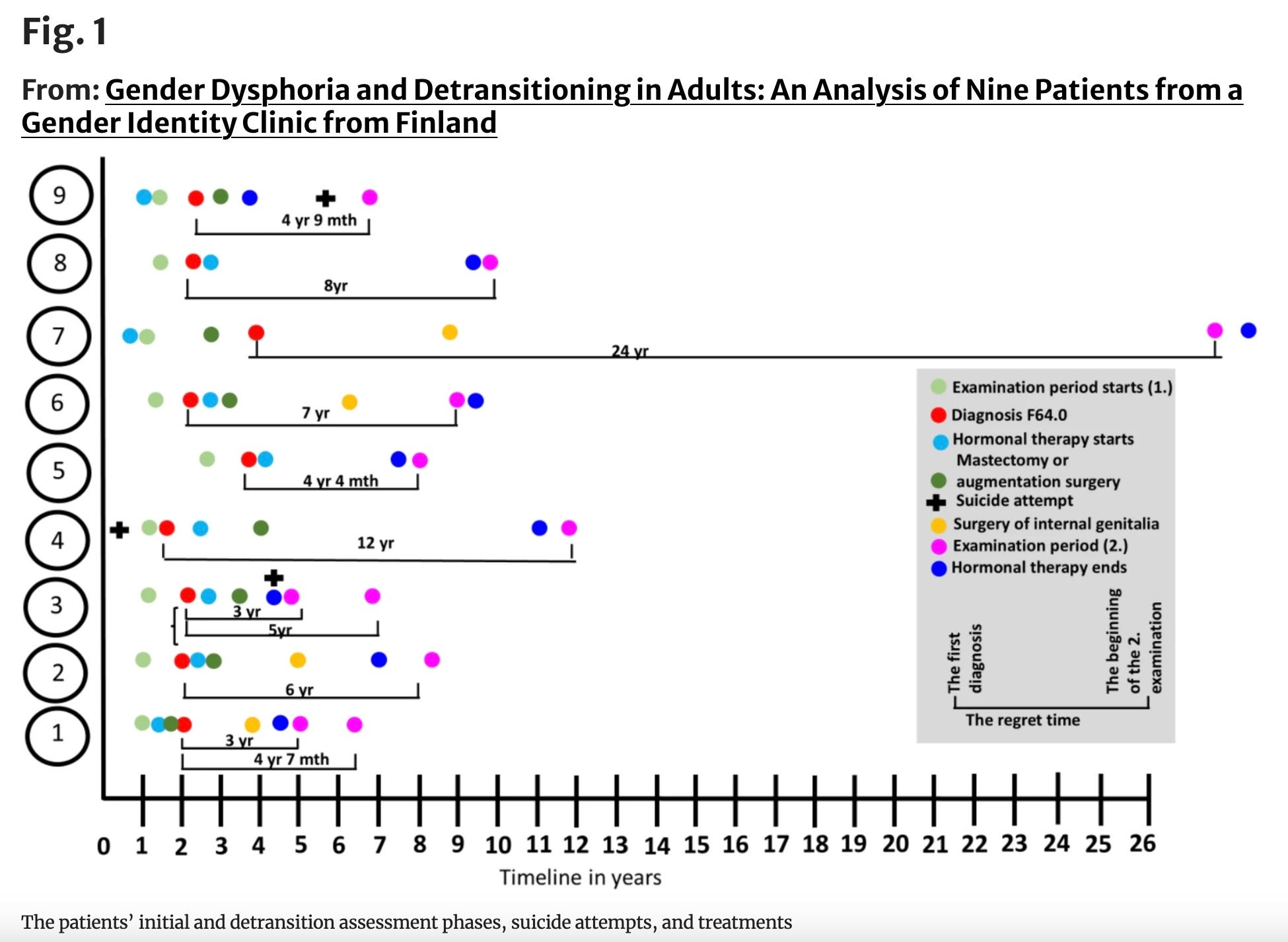
(Note: The authors also excluded from their analysis 1 patient who detransitioned after starting hormones and was diagnosed with psychosis, which they conclude to mean the patient’s detransition was “not logically reasoned.” No further details are provided, and I don’t want to speculate, but I do want to make the point that detransitioners with psychotic disorders can still make reasoned decisions about their gender identity/expression and act on a desire to detransition. All of the 7 AFAB patients have “major regret” which means they developed iatrogenic/reverse gender dysphoria from treatment. The 2 AMAB patients have “minor regret” which could mean discrimination, lack of support, health reasons prompting detransition).
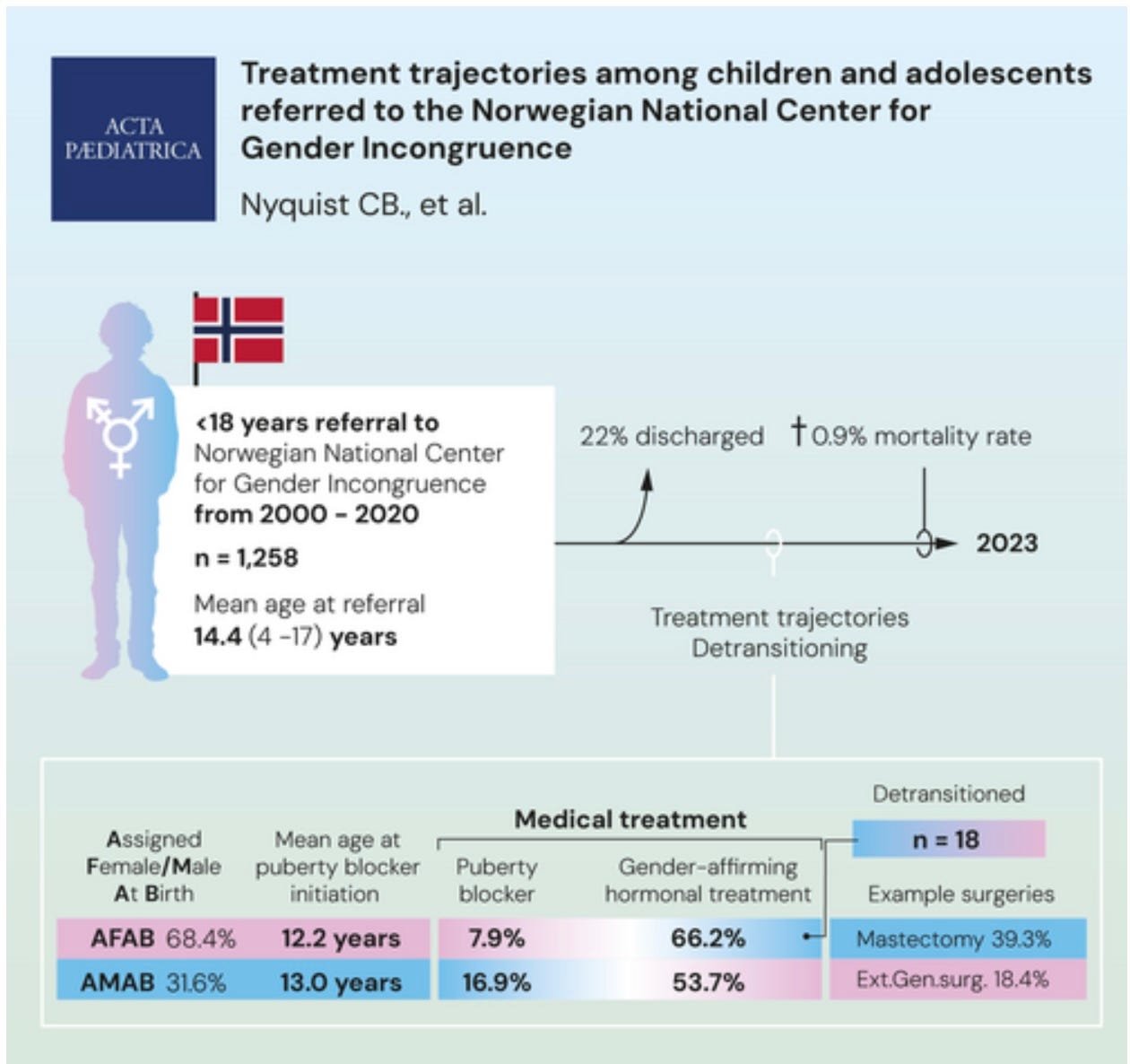
And here is another recent study published in 2024 looking at pediatric transition-related treatment referrals and detransition in Norway, authored by Nyquist et al. 100% of discontinuation/detransitions were observed among AFAB patients:
The percentage of core and non‐core detransitioners combined per treatment year for AFAB from 2015 to 2021 varied between 1.3% (1/79) and 10.2% (6/59), with 2018 as the peak year.
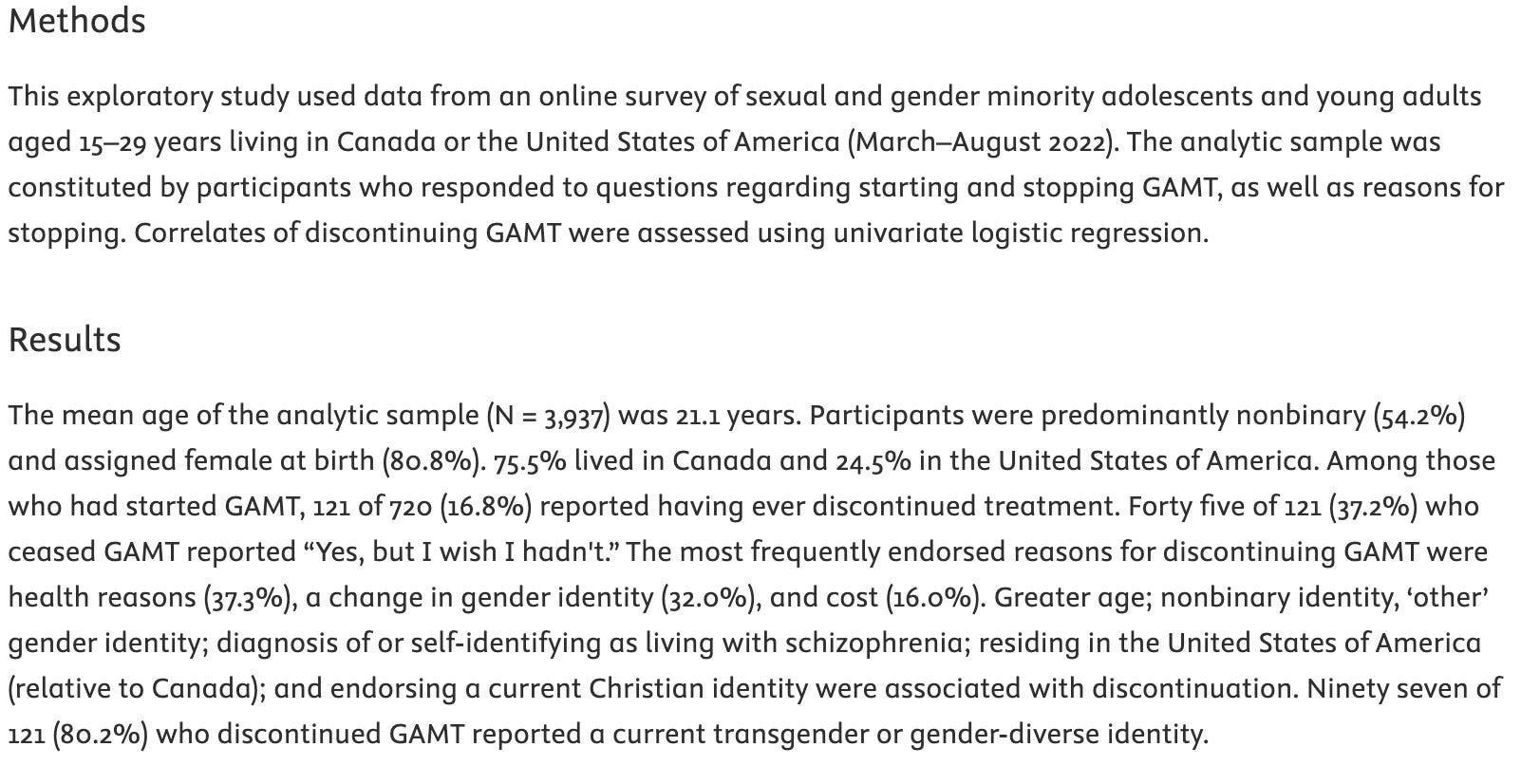
Here’s another one from a Canada/US community survey: Published in 2024, I collaborated with some gender clinicians, trans, nonbinary, and detrans researchers to explore discontinuation of gender-affirming treatments. This was a non-probability sample of thousands of 2SLGBTQ+ youth/young adults with a large majority being Canadian (75%) and the rest were living in the US. In this survey, those who reported ever starting gender-affirming medical treatment we asked the question: “Have you ever stopped/reversed treatment?” Of the subsample who reported having ever accessing gender-affirming treatment, 16.8% responded yes to having stopped/reversed, and of those, 80.2% affirmed a trans or nonbinary identity at the time of taking the survey (please note that we also asked about regret with having stopped treatment, and various reasons for stopping. No data on satisfaction/regret with treatments were collected):
Now, how to interpret detransition research raises philosophical and clinical questions. The numbers can miss the forest for the trees. This is why there is so much value in qualitative research. If you’d like to review more of the minutia of factors associated with detransition and what is emerging from the latest research, feel free to check out The One Percent, co-authored by me and clinical psychology PhD student, Pablo Exposito-Campos:

Now, finally, the op-ed!
There are a couple of key aspects I would want to change if it were re-written today. For example, I would update it to reflect the current political context in the US, anti-science and anti-intellectualism, and increasing restrictions being placed on not only pediatric trans care, but also adult care. Overall, though, I think it remains an empirically accurate representation of the emergence of detransition as a clinical and socio-political phenomena of the mid-2010s-early 2020s, grounded in medical and social sciences research. I’m certain that ideas and interpretations about detransition and this time in history will change and evolve as the years pass, but for now, I think it still stands.
Take Detransitioners Seriously
Some people reverse their gender transition. Understanding their experience is crucial.
When Kristin Beck, a decorated Navy Seal veteran, came out as a transgender woman in 2013, she became a high-profile advocate for the trans community—a role that earned her glowing coverage in left-wing and mainstream center-left media. But unless you’ve been reading right-wing websites in recent months, you might never know that Beck has since detransitioned and gone back to the name Chris Beck. Last month, Beck declared that he had “lived in hell for the past 10 years.” Most of the outlets that reported with enthusiasm on Beck’s initial transition have yet to cover the latest chapter in his life story.
Both of us are trans academics. One of us studies the history of trans activism; the other recently studied detransitioners’ experiences in depth. We strongly oppose efforts, in state legislatures and elsewhere, to target trans children and their families and pass laws restricting treatment options for gender dysphoria, a condition that the American Psychiatric Association’s diagnostic manual defines as impairment or distress over an incongruence between a person’s gender identity and their gender assigned at birth. But trans-rights advocates and mainstream-media outlets should stop downplaying the reality of detransition, lest readers and viewers conclude that it’s a negligible issue. It’s not.
For years, the detransition rate was thought to be in the low single digits. In a landmark study of people in Sweden who changed their legal sex from 1960 to 2010, 2 percent applied to return to their sex assigned at birth. Other studies suggest an even lower detransition rate. But data are relatively scarce, and anyway the cultural context for trans people has since evolved so much and so quickly that older studies may not adequately predict outcomes for today’s far larger, more diverse trans and gender-questioning population.
Gender-nonconforming people deserve compassionate attention in all their complexity. Ignoring detransitioners’ experience isn’t just harmful to them; it also means that doctors and scientists miss out on much-needed data that could improve gender-affirming care for future patients.
People who reverse a previous transition—some of whom call themselves detransitioners; others may identify as nonbinary or refuse labels altogether—do so for a variety of reasons. Some people simply cannot bear the discrimination that openly trans people so often face; society’s transphobia is a major barrier to living happily. But some detransitioners realize, after years of living as a trans person, that they are instead lesbian, gay, or bisexual. Other detransitioners come to discover that what they thought was only gender dysphoria may have instead reflected a more complex picture—perhaps including a neurodivergence, the aftermath of a past trauma, or some other mental-health challenge. Although many detransitioners do appreciate the opportunity for self-discovery that their transition provided, others would not take the same steps if they could go back in time.
To many in the trans and nonbinary community, detransition stories—especially those that involve regret—seem to jeopardize half a century of hard-won gains for civil rights and access to health services. Detransition has become a political cudgel to challenge any and all gender care for young people. This may be one reason right-wing outlets have prominently featured Beck, who has urged trans youth to “slowdown” in order to avoid his own fate. Never mind that Beck explicitly states that he is not against trans people or gender-related medical care.
Unfortunately, some people who discuss their detransition on social media are met with suspicion, blame, mockery, harassment, or even threats from within the LGBTQ communities in which they previously found refuge. Some trans-rights advocates have likened detransitioners to the ex-gay movement or described them as anti-trans grifters. In fact, many detransitioners continue to live gender-nonconforming and queer lives. No one benefits from the anger and suspicion that gender-care issues currently inspire. Detransitioners who face social rejection, coupled with shame and isolation, may come to view anti-trans activists as their only allies—even when those activists portray them negatively, as damaged goods rather than as human beings who have survived medical trauma. Meanwhile, clinicians who receive threats of violence for assisting trans youth are vulnerable to developing myopic positions and overly optimistic clinical practices that ignore detransitioners’ accounts.
Opponents of gender care for youth aren’t just capitalizing on stories like Beck’s; they are also weaponizing scientific uncertainty. The existing research has major gaps. Much of the recent evidence is based on follow-ups conducted about two years or less after a patient initiates a transition. But the few studies that have examined detransition suggest that the average time to detransition can be about four to eight and a half years. And detransitioners may avoid returning to the same clinician who helped them start the process; some discontinue medical care altogether. So any studies that rely exclusively on understanding detransition from patient medical records will underestimate this outcome.
The need to know more about detransition is all the more urgent amid a surge of new patients lining up at gender clinics. This increase in caseloads follows two major changes that have reshaped this field. The first is that more and more doctors have stopped acting as gatekeepers, and for good reason.
For many decades, lengthy, invasive, and stigmatizing evaluations preceded access to hormonal therapy and surgeries. The original model of transgender medicine sought to assess how likely patients were to blend into cisgender society as heterosexual people. Physicians based their judgments on patients’ physical appearance, sexual orientation, and mental-health status. In other words, a trans woman who looked female in a doctor’s opinion, was attracted to men, and had no other diagnosed mental-health issues was more likely to be approved for hormone treatment and surgery. Trans activists successfully—and rightly—challenged these paternalistic restrictions, spurring a transformation in medical practice. Many doctors and clinics today expedite the medical-transition process based on the principle of patient autonomy rather than letting doctors control trans people’s bodies. Some gender-care providers’ websites now express a willingness to prescribe hormones during a patient’s first visit.
The second major change involves greater social acceptance of gender-nonconforming people—and an accompanying expansion of the pool of potential patients for gender care. In the past decade or so, most American insurance providers have begun covering at least some gender surgery based on a dysphoria diagnosis. Most research on the effects of medical and surgical interventions involves patients whom doctors have deemed to have that condition.
But more and more, the prevailing popular definitions of terms such as trans and nonbinary do not necessarily include a dysphoria diagnosis. For many people, gender identity can be fluid, but no one needs a doctor’s permission to be trans. Trans and nonbinary people who do not have dysphoria can still seek out, and benefit from, medical treatment that better aligns their body with their gender identity.
The growth of trans, nonbinary, and queer culture, along with the normalization of gender transitions, now provides a haven in which body modifications achieved through medical interventions are accepted and even celebrated. But researchers don’t yet have enough data to know whether today’s patients will detransition at higher or lower rates than the patients who were approved for treatment in decades past. A British study, published last year, of more than 1,000 young people indicates that some trans people express shifting desires about the kind of care they need; two other, smaller studies show that seven to 10 percent of patients who were assessed for gender-related medical services later changed their gender or otherwise met qualifications for detransition. A study of 68 trans youth seeking medical gender care in the U.S. found that 29 percent of these patients shifted their treatment requests with respect to hormones, surgeries, or both. Nonbinary youth were more likely than trans girls or trans boys were to shift their treatment requests. Another U.S. study published last year found that, for reasons that remain unknown, 30 percent of patients who begin gender-related hormone treatment discontinue it within four years.
Some recent research upholds a lower detransition rate. Researchers in theNetherlands found that only 2 percent of trans young people discontinued gender-affirming hormones within about four years of going on puberty blockers.Interviewed by Reuters, the lead author, Marianne van der Loos, explained that the youth had mental-health support and diagnostic evaluations for an average of one year prior to starting treatments. Ultimately, nothing is certain from these data except that more information is necessary, and that our community needs to talk about this issue. For patients to give informed consent to medical treatment, they need to know about the range of possible outcomes. Meanwhile, doctors and clinics need guidelines and services to support people who wish to detransition, but to our knowledge no formal standards are widely accepted across the gender-care field.
Even if the 2 percent figure holds, the absolute number of detransitioners is likely to increase dramatically as more trans and nonbinary people elect medical and surgical treatments. Will the LGBTQ community support or shun these people? Can researchers design gender care that affirms trans people’s identities without viewing detransitioners as collateral damage in the fight for fair treatment? A transition can be beneficial to some people but “hellish” for others, as it was for Beck. These are not opposing political viewpoints. They simply reflect a wide range of real outcomes of medical interventions that can fundamentally transform a person’s body and their life.
The LGBTQ community today must still contend with attacks on gender and sexual diversity—but is also at a moment of unprecedented cultural, institutional, and political strength. Those of us who believe in LGBTQ-inclusive health care and bodily autonomy must recognize that some of our hard-earned wins may have introduced new uncertainties. Upholding the dignity and diversity of trans, nonbinary, and gender-nonconforming populations should not be at odds with a data-informed medical approach that seeks to maximize positive outcomes for all. Gender-affirming care must be available to those who need it. But our community must also advocate for the research to help transitioning patients thrive in the long run—regardless of their individual outcome.


among other things, sorry you got michael hobbes’d
I really admire and respect your intellectual honesty and commitment to genuine research.
I wish you could extend that openness to considering the idea that efforts to limit pediatric gender medicine are based on 1. Ethical principles and the difficulty of obtaining true informed consent from children and adolescents and 2. On the uncertain balancing of the serious iatrogenic harms (to brain, bone cardiovascular, reproductive, uro-genital, sexual and endocrine health) against the low-quality evidence establishing long-term positive mental health outcomes.
Or would that be too heretical?